

PROJECT OVERVIEW
Understanding external stressors
Generate a better understanding, for governments and economic actors involved in the cereal value chain in the MENA region, of the external stressors and shocks that derive from global value chains (GVCs) and threaten local cereal supply chain and food security.
Developing resilience strategies
Develop innovative solutions and evidence-based recommendations for strategies, action plans, and best practices that governments and economic actors of the MENA food systems along the cereal value chain can use to enhance system resilience and ensure food security.
Improving stakeholder preparedness
Improve the preparedness of governments and economic actors along the cereal value chain to anticipate and cope with external stressors by integrating new knowledge and data into a Dashboard and Decision Support System for the adoption of solutions and best practices.
Strengthening food security in the MENA region
The STAPLES (STable food Access and Prices and Lower Exposure to Shocks) project addresses critical issues of food security in the MENA region, where countries heavily rely on cereal imports for their population’s dietary needs. Egypt and Morocco, among others, stand out as significant importers, highlighting the vulnerability of their food systems. Recognizing the necessity for a comprehensive approach, the project focuses on understanding the entire cereal value chain, domestically and globally. By integrating stakeholders’ knowledge and adopting a multi-dimensional strategy, the project aims to enhance the resilience of the MENA region’s food systems.
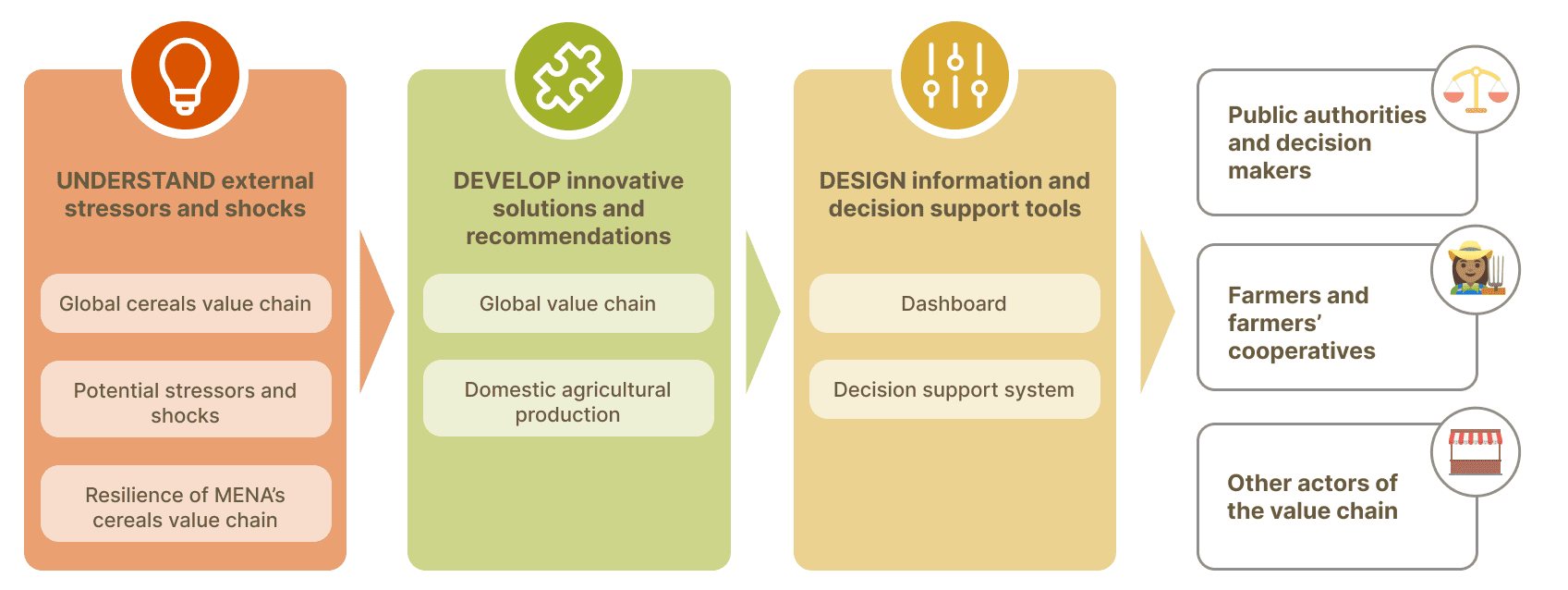
Integrating interdisciplinary solutions
The project adopts an interdisciplinary methodology, drawing expertise from various sectors including economics, engineering, legal studies, and ethnobiology. This interdisciplinary approach ensures a holistic understanding of the challenges and opportunities within the cereal value chain. Key elements of the methodology include a focus on results orientation and user-centeredness. Digital technologies and decision support tools play a central role, facilitating data collection, analysis, and dissemination of findings. Stakeholder engagement is paramount throughout the project, ensuring alignment with user needs and fostering collaboration for data collection, validation, and dissemination. By targeting diverse stakeholders including EU producers, smallholder farmers, local authorities, and the general public, the project aims to develop solutions that address the specific needs of each group, ultimately contributing to the resilience of the MENA region’s food systems.
In addition to the scientific work packages, the project also includes work packages WP5 for communication, dissemination, and exploitation management and WP6 for project management.
Work Package 1
Understanding external stressors and shocks
Work Package 1 focuses on enhancing our understanding of the risks within the cereal value chain. Through comprehensive analysis, it seeks to identify vulnerabilities and potential disruptions, providing insights to inform resilience-building strategies.
Work Package 2
Developing innovative solutions and evidence based recommendations: Global Value Chain
Work Package 2 develops innovative solutions to enhance domestic agricultural production within the MENA region. By addressing challenges such as water scarcity and land management, the aim is to bolster local food production capacity and reduce dependency on imports.
Work Package 3
Developing innovative solutions and evidence based recommendations: domestic agricultural production
Work Package 3 is dedicated to enhancing resilience within the global value chain. By examining factors such as trade dynamics, market fluctuations, and supply chain disruptions, this phase aims to identify strategies to mitigate risks and ensure stability in cereal supply.
Work Package 4
Designing information and decision support tools
Work Package 4 focuses on the practical implementation of decision support tools and digital technologies. By providing policymakers and economic actors with access to relevant information and support systems, it aims to improve preparedness and resilience across the cereal value chain.
Operational recommendations for food system resilience
Developing innovative solutions and evidence-based recommendations for better public procurement systems, grain storage, and risk mitigation strategies to enhance resilience and food security in the Mediterranean region.
Awareness promotion about sustainable production
Promoting awareness about traditional rainfed cereals and water-intensive value chains, fostering informed decision-making toward sustainable development across the Mediterranean region.
Regional cooperation and international competitiveness
Making available evidence that allows improved trade and investment decisions and policies, toward the enhancement of market opportunities and international competitiveness of the MENA countries within the framework of stronger cooperation in Mediterranean region.
Innovative solutions for stakeholders
Co-designing affordable multipurpose agricultural machine for smallholders and developing IT tools, such as a Dashboard to improve information and preparedness of governments and economic actors in anticipating and coping with external stressors and shocks, and a Decision Support System to orient stakeholders strategies.

